




Author
Subscribe to our newsletter
Earlier this year, researchers, engineers, and laboratory scientists gathered at the Hilton Mystic in Connecticut for the 2nd International Conference on Iron-Sulfide Reactions in Concrete (ICISR 2026). Among the technical papers presented was Petrographic Methods to Identify and Quantify Iron-Sulfide Minerals in Aggregate, co-authored by Michael Baker and Chesney DeTullio of RJ Lee Group, and April Snyder and Blake Restelli of ECS Mid-Atlantic.
The conference brought renewed attention to a question the concrete industry continues to face: How do you reliably identify a mineral that may be present only at trace levels in an aggregate source but can significantly affect concrete durability?
A very small target
In states such as Connecticut and Massachusetts, where iron-sulfide reactions have been tied to failing residential foundations, a total sulfur content of 0.1% or greater by weight in concrete aggregate triggers the need for further evaluation, including petrographic examination. In mineralogical terms, that level can correspond to a pyrrhotite content as low as approximately 0.15% by weight.
Detecting a mineral at such low concentrations is difficult. Standard petrographic methods are highly effective for characterizing aggregate lithology, but identifying and estimating trace quantities of specific iron-sulfide minerals presents unique challenges.
|
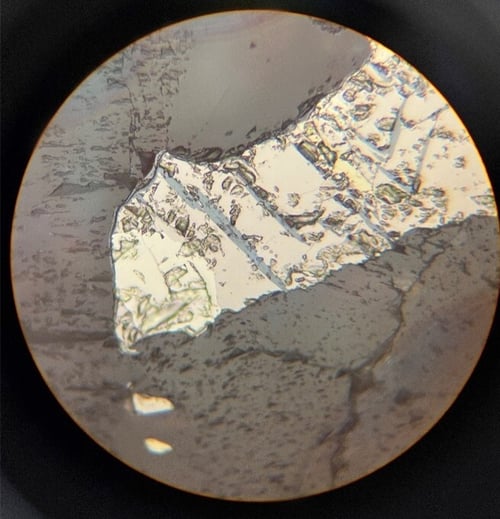
A representative pyrrhotite sample shows a creamy pinkish-brown color and common pitting, accompanied by chalcopyrite, which shows a brassy-yellow, bright, and reflective appearance. Pentlandite is also present in the sample. |
Where ASTM C295 reaches its limits
ASTM C295/C295M, Standard Guide for Petrographic Examination of Aggregates for Concrete, is the workhorse standard for aggregate characterization. It is well suited for identifying rock types, textures, and constituents that may influence concrete performance. However, the method is primarily oriented toward transmitted-light thin-section analysis for lithological characterization, while iron-sulfide minerals are opaque in transmitted light.
For trace pyrrhotite detection, several challenges arise:
- Opacity. Sulfide minerals do not transmit light, making transmitted-light microscopy less effective for distinguishing among sulfide species or differentiating them from some high-reflectance oxides.
- Trace abundance. At regulatory thresholds, target minerals may occur only rarely within a sample, making representative evaluation more difficult.
- Co-association. Pyrrhotite commonly occurs alongside pyrite, chalcopyrite, pentlandite, and other sulfide minerals, often at the micron scale, which makes accurate identification more challenging.
ASTM C295 permits the use of reflected-light microscopy and scanning electron microscopy (SEM) when needed, but it does not prescribe a specific workflow for identifying and estimating trace amounts of iron-sulfide minerals. This challenge was one of the topics discussed at ICISR 2026.
A presentation from RJ Lee Group and ECS Mid-Atlantic
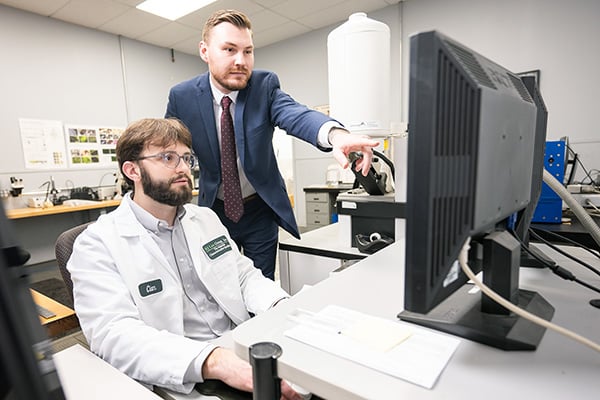
Among the technical papers presented at the conference was a collaboration between RJ Lee Group and ECS Mid-Atlantic titled Petrographic Methods to Identify and Quantify Iron-Sulfide Minerals in Aggregate. The paper outlines a practical methodology that builds upon ASTM C295 by combining reflected-light microscopy with SEM/EDS analysis.
Step 1: Reflected-Light Microscopy
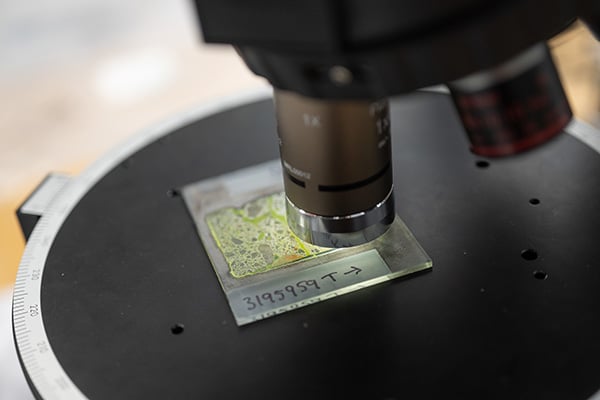
Representative coarse and fine aggregate samples are prepared as polished epoxy pucks and examined using reflected-light microscopy at magnifications up to 1000×.
Using reflected light, petrographers can distinguish among common iron-sulfide minerals based on optical characteristics such as color, reflectance, anisotropy, bireflectance, and surface texture. For example:
- Pyrite typically appears yellow-white with a smooth texture and weak anisotropy.
- Pyrrhotite often exhibits a creamy pinkish-brown appearance, higher reflectance, pitting, and pleochroism.
- Chalcopyrite displays a brassy-yellow color.
- Pentlandite generally appears creamy white with a slight pinkish tint and is isotropic.
For coarse aggregate samples, particles larger than 3 mm are mapped and numbered, creating a consistent reference system for documenting sulfide occurrence and distribution throughout the sample.
Step 2: SEM/EDS Confirmation
Reflected-light observations are then supported by scanning electron microscopy with energy-dispersive X-ray spectroscopy (SEM/EDS).
SEM backscattered electron imaging provides compositional contrast and reveals micron-scale textures that may not be readily visible optically. This includes features such as framboidal pyrite morphology, sulfide intergrowths, and compositional variations within individual grains.
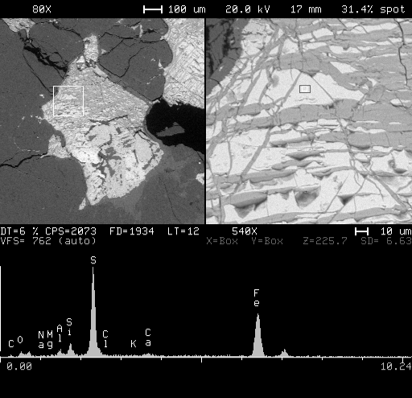
Backscattered electron (BSE) images with EDS spectrum showing
an iron-sulfide deposit in aggregate composed of multiple phases, each
identified through its Fe–S ratios and variations in BSE brightness.
EDS analysis further assists in differentiating sulfide minerals by evaluating elemental composition and generating X-ray phase maps that visually separate mineral phases throughout a field of view.
SEM/EDS is not intended to replace petrographic examination. Rather, it serves as a complementary tool that increases confidence in mineral identification and helps resolve complex sulfide assemblages that may be difficult to characterize using reflected light alone.
Estimating Relative Abundance
The methodology combines petrographic observations with measured sulfur data to estimate the relative abundance of individual iron-sulfide minerals within an aggregate sample.
By integrating reflected-light microscopy, SEM/EDS characterization, and image analysis, the approach provides additional insight into the types, distribution, and relative proportions of sulfide minerals present. This information can help improve confidence in aggregate evaluations where pyrrhotite is a concern and support a more detailed understanding of sulfide mineral occurrence within the aggregate source.
The Takeaway
The methodology presented at ICISR 2026 reflects the direction in which this area of research is moving. ASTM C295 remains the foundation of aggregate petrography, but projects involving aggregate sources with known iron-sulfide concerns may benefit from additional analytical tools.
The combined use of reflected-light microscopy and SEM/EDS provides a more reliable basis for identifying and estimating the abundance of iron-sulfide minerals than conventional petrographic methods alone. Rather than simply reporting that sulfides are present, the approach helps develop a more defensible estimate of the relative abundance and distribution of specific sulfide minerals within an aggregate sample.
If your project involves aggregate from regions with known iron-sulfide concerns, the most appropriate analytical approach will depend on the aggregate source, regulatory requirements, and the decisions the results are intended to support. Understanding not only whether sulfides are present but also which sulfide minerals are present and how they occur within the aggregate can provide valuable information for evaluating long-term concrete durability.
Contact our petrography experts to discuss the right approach for your project.