




Fourier Transform Infrared Spectroscopy (FTIR) is an analytical technique used to identify organic, polymeric, and inorganic materials. FTIR is commonly used to identify unknown substances, verify material composition, detect contaminants, and analyze complex mixtures in applications including pharmaceuticals, forensics, environmental science, and materials testing.
Instrumentation
Fourier Transform Infrared Spectroscopy (FTIR)
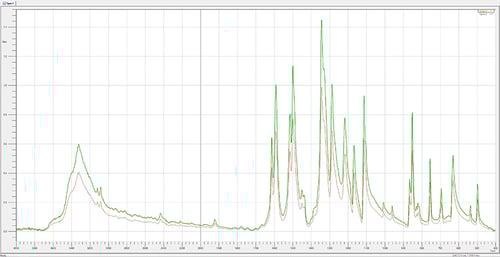
A typical FTIR spectrum display
What is FTIR?
FTIR works by directing a broad spectrum of infrared light at a sample and measuring the amount of light absorbed at each wavelength. The instrument utilizes an interferometer to modulate the infrared light and generate an interferogram—a signal that contains information about all infrared frequencies simultaneously. This interferogram is then processed using a mathematical technique called Fourier Transform to convert it into an infrared absorption spectrum.
The resulting spectrum displays peaks corresponding to specific molecular vibrations, which are characteristic of the chemical bonds and functional groups present in the sample. This allows for precise identification and analysis of the material’s composition.
RJ Lee Group utilizes advanced instrumentation to provide our customers with the most insights possible. We employ all three major FTIR sampling techniques: Transmission, Reflectance, and ATR (Attenuated Total Reflectance).
FTIR Microscopy (Micro-FTIR)
For samples that are too small for conventional FTIR, such as fibers, particles, thin coatings, or microtomed sections, RJ Lee Group offers FTIR microscopy using the PerkinElmer Spotlight™ 200i. This system combines an infrared microscope with FTIR detection, so we can collect chemical spectra from small areas of a sample instead of from the whole sample.
The Spotlight 200i supports four sampling modes, giving us flexibility across sample types:
- Transmission — thin films, microtomed sections, salt plate samples
- Reflectance — coatings, thick solids, surface defects
- ATR (Attenuated Total Reflection) — hard solids, polymers, particles, multilayers
- Mapping & Line Scans — spatially resolved chemical analysis across a sample area
This versatility makes it a strong fit for polymer and materials analysis, failure and defect analysis, forensics (fibers, paints, and particles), pharmaceutical formulation and contamination studies, and particulate identification.
Where bulk FTIR tells you what a sample is made of, micro-FTIR tells you what a specific feature within that sample is made of—bridging the gap between optical microscopy and spectroscopy.
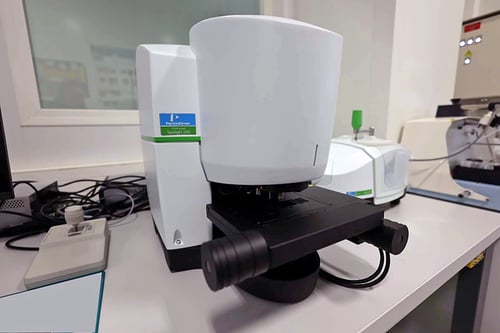
Micro-FTIR combines an infrared microscope with FTIR detection
What Can You Do With FTIR?
FTIR is a versatile tool used across many industries for material identification, quality control, and failure analysis.
- Pharmaceuticals
Verify the identity and purity of raw materials, detect counterfeit drugs, and analyze formulations for quality assurance and regulatory compliance. - Polymers and Plastics
Identify polymer types, analyze additives or fillers, and investigate product failures caused by contamination or degradation. - Environmental Testing
Detect pollutants, monitor air quality, and analyze soil or water samples for organic contaminants like hydrocarbons or pesticides. - Automotive and Aerospace
Examine materials like lubricants, sealants, and composite components to ensure they meet performance standards and to investigate the causes of part failures. - Art Conservation
Identifying pigments, binders, and varnishes in artworks, helping conservators choose appropriate preservation and restoration methods.
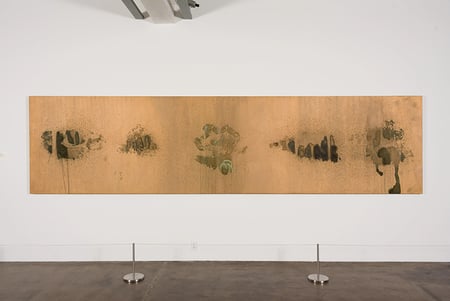
FTIR was used to investigate changes in Andy Warhol's Oxidation painting
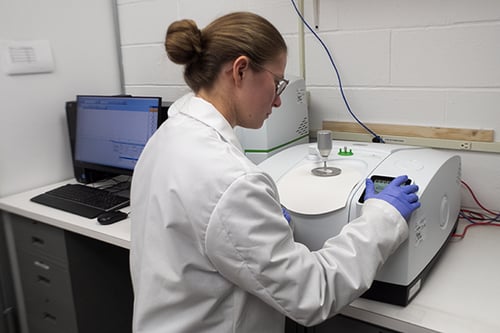
Expert FTIR Analysis
Why Choose RJ Lee Group for FTIR Analysis?
Expert FTIR Analysis
We bring decades of scientific experience and advanced laboratory technology, including both transmission and ATR capabilities, to every project.
Comprehensive Identification
Our scientists expertly identify organic and inorganic compounds—even in trace amounts—to assist with material verification, failure analysis, and troubleshooting production issues.
Actionable Insights
We do more than provide results—we give you clear, practical answers to address your challenges.
Integrated Solutions
FTIR analysis is enhanced by integration with advanced techniques such as SEM/EDS, TGA, and GC-MS, providing a complete understanding of your material concerns.
We bring decades of scientific experience and advanced laboratory technology, including both transmission and ATR capabilities, to every project.
Comprehensive Identification
Our scientists expertly identify organic and inorganic compounds—even in trace amounts—to assist with material verification, failure analysis, and troubleshooting production issues.
Actionable Insights
We do more than provide results—we give you clear, practical answers to address your challenges.
Integrated Solutions
FTIR analysis is enhanced by integration with advanced techniques such as SEM/EDS, TGA, and GC-MS, providing a complete understanding of your material concerns.
Get in Touch
Contact RJ Lee Group today to learn how our expert FTIR testing can support your material composition analysis needs. Our advanced FTIR capabilities allow us to identify organic and inorganic compounds, detect contaminants, and verify material integrity across a wide range of industries.
Whether you're in manufacturing, environmental science, or research and development, our FTIR analysis—combined with elemental analysis and non-destructive testing—delivers accurate, reliable results tailored to your specific challenges.
Blog
Read More
2 min read
Environmental testing is getting more complex. Your laboratory partner should be keeping up.
September 15, 2026