





Author
Subscribe to our newsletter
Degradation Mechanisms in Asbestos Cement Pipes
Asbestos cement (AC) pipes were first introduced in North America in 1929 and became widely used in water distribution systems from the 1940s to the 1970s1. Composed of asbestos fibers, Portland cement, and sand, these materials have historically provided durability and cost-effectiveness, making AC pipes a popular choice in infrastructure for decades. Although AC pipes have an estimated lifespan of 70 years, their durability varies with environmental conditions, water chemistry, and maintenance practices2. Over time, degradation can compromise structural integrity, necessitating accurate assessment methods to determine remaining service life.
A range of techniques is available for evaluating AC pipe degradation, from traditional methods such as phenolphthalein staining to advanced analytical tools like scanning electron microscopy (SEM) and energy-dispersive X-ray spectroscopy (EDS). Phenolphthalein staining remains valuable for identifying carbonation fronts and visually assessing chemical changes in the cement matrix. However, SEM and EDS provide greater precision and insight by enabling detailed microstructural analysis and detection of chemical changes within the pipe’s cement matrix, offering a deeper understanding of pipe deterioration.
SEM/EDS Analysis for Assessing Degradation
SEM, combined with EDS, is a critical tool for diagnosing AC pipe degradation. It provides high-resolution imaging and elemental analysis as a function of position. This technique enables a detailed evaluation of microstructural and chemical composition changes across the pipe wall, allowing for precise identification of deterioration depth and severity.
SEM imaging reveals micro-structural features such as cracks, voids, and changes in cement texture caused by leaching, while EDS provides semi-quantitative elemental data, mapping calcium, silicon, and other key elements, including those associated with environmental species of interest.
By collecting elemental composition profiles at multiple depths across the pipe wall—often evenly spaced from interior to exterior—engineers can map decalcification progression and pinpoint the most affected areas (Figures 1 and 2).
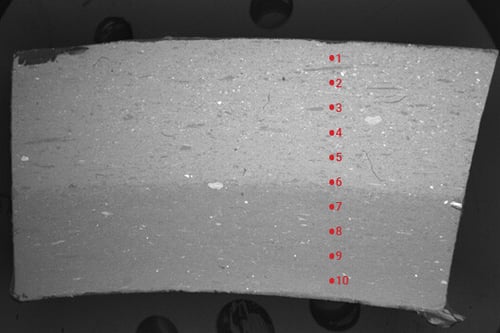
| Figure 1. Wide-field backscattered electron (BSE) overview image of AC pipe cross section showing ten spectra locations at evenly spaced intervals along the thickness of the pipe wall. |
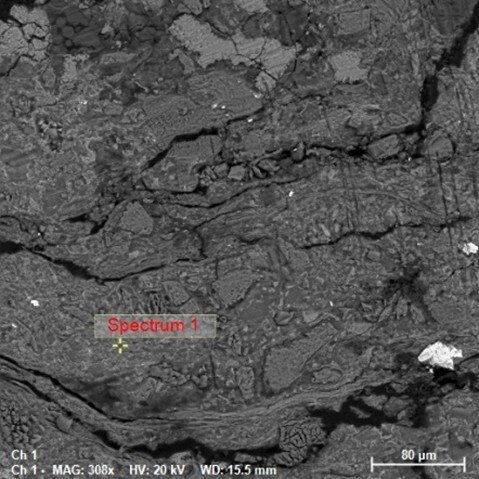
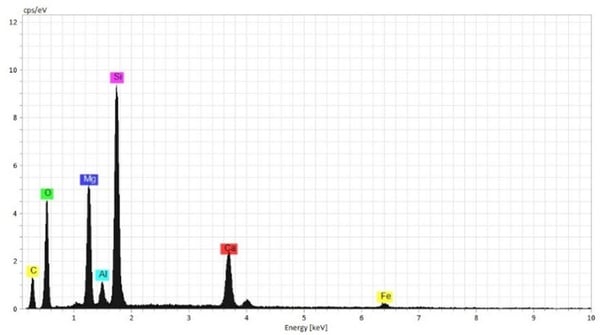

Figure 2. BSE image with EDS spectrum showing normalized mass concentration (wt.%) of selected elements within decalcified regions along the external surface of the AC pipe. |
Visualizing Calcium Depletion in AC Pipes
To illustrate the impact of different degradation mechanisms further, the effects of carbonation alone and the combined effects of carbonation and calcium leaching are compared.
Figure 3 presents calcium concentration data collected from AC pipe samples at varying depths from the pipe surface. It demonstrates that leaching extends the degradation zone beyond what is indicated by carbonation alone, leading to a deeper loss of calcium and increased long-term vulnerability. These findings reinforce the importance of integrating advanced analytical techniques such as SEM/EDS into routine assessments.
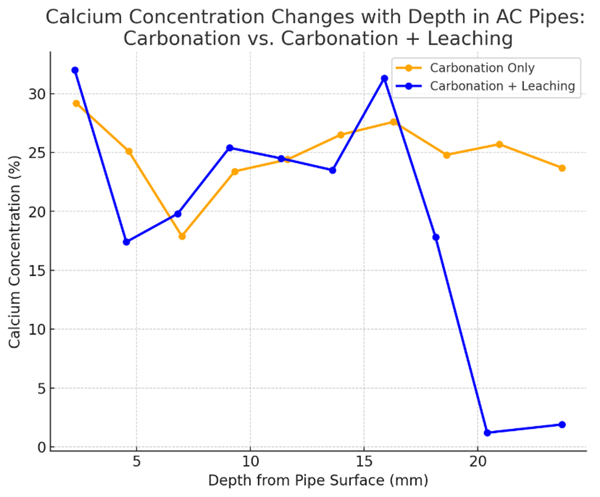
| Figure 3. Calcium concentration trends as a function of depth for AC pipes affected by carbonation alone (yellow) versus carbonation combined with calcium leaching (blue). The data highlights the significant impact of calcium leaching, which results in a deeper depletion zone and greater material loss than carbonation alone. This finding underscores the advantages of advanced analytical methods for accurate assessment of pipe deterioration and estimating remaining service life. |
A Higher Standard for AC Pipe Assessment
With the addition of SEM/EDS analysis to AC pipe assessments, engineers can achieve a more comprehensive evaluation of AC pipe degradation than with petrographic staining alone. Quantifying microstructural and chemical changes provides valuable insights that enhance confidence in service life estimations. As infrastructure ages, adopting a combination of these techniques will be essential for ensuring long-term serviceability and reducing unexpected failures.