




Instrumentation
Gas Chromatography Analysis
At RJ Lee Group, we specialize in solving complex analytical problems with precision and speed. Gas chromatography is one of our most powerful tools for identifying and quantifying volatile and semi-volatile organic compounds across a wide range of industries. Whether you're facing regulatory hurdles, contamination concerns, or product quality issues, we deliver the clarity you need to move forward with confidence.
Types of Gas Chromatography
RJ Lee Group utilizes several powerful types of gas chromatography instruments to expand our capabilities and deliver actionable results for our clients.
Gas Chromatography - Mass Spectrometry (GC-MS)
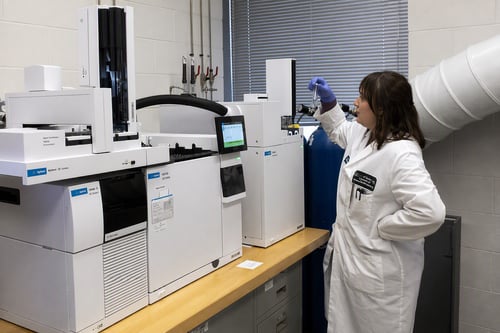
GC-MS combines the separation capabilities of gas chromatography with the molecular identification power of mass spectrometry. This technique allows for the detection of trace-level compounds in complex mixtures, making it ideal for environmental testing, industrial hygiene, pharmaceutical analysis, and forensic investigations. GC-MS is widely recognized for its sensitivity, specificity, and ability to identify unknown substances with high accuracy.
Gas Chromatography–Electron Capture Detection (GC-ECD)
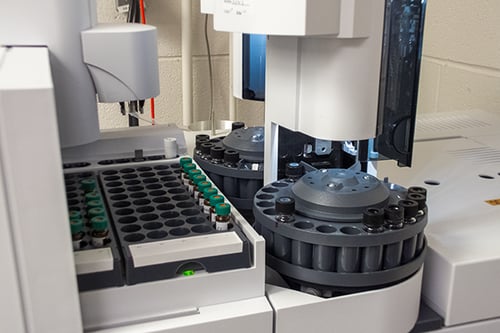
GC-ECD is a specialized gas chromatography technique that uses an electron capture detector to identify compounds with high electronegativity, particularly halogens. The detector employs a radioactive source to ionize the carrier gas, and when electronegative compounds pass through, they capture electrons—resulting in a measurable drop in current. This makes GC-ECD exceptionally sensitive to substances like chlorinated pesticides, PCBs, and other persistent organic pollutants.
Gas Chromatography–Flame Ionization Detection (GC-FID)
GC-FID is a gas chromatography method that uses a flame to ionize organic compounds as they exit the chromatographic column. These ions are then detected and quantified, providing precise measurements of compound concentrations. GC-FID is especially effective for analyzing non-polar organic compounds such as solvents, fuels, and industrial emissions.
Gas Chromatography–Mass Spectrometry with Automated Headspace Sampling (GC-MS/HS)
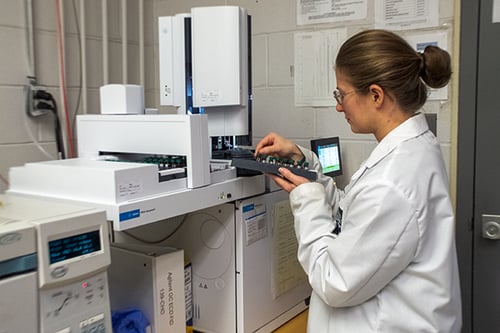
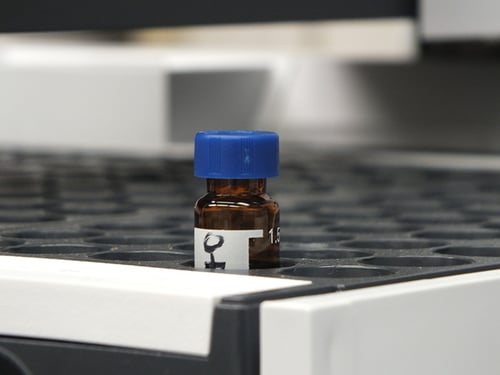
Headspace GC-MS combines the separation and identification power of GC-MS with automated sample preparation in a sealed vial. The sample is heated, and only the vapor above it—the "headspace"—is introduced to the GC column, eliminating matrix interference and extending column life.
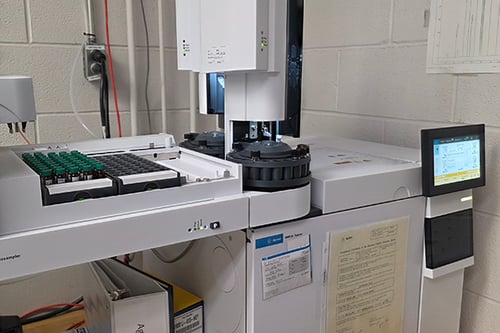
At RJ Lee Group, we run this on the Agilent 8890 GC, 5977C MSD Inert Plus, 7693A Autosampler, and 8697 Headspace Sampler—a robust single-quadrupole platform built for both routine quantitation and unknown identification. This configuration delivers high sensitivity (ppb levels), excellent reproducibility, minimal matrix interference, and automated high-throughput workflows.
Applications include residual solvents in pharmaceuticals (USP <467>), VOCs in soil and water (EPA 5021A, 5035, 8260), outgassing and packaging studies, unknown volatile identification, and trace contamination troubleshooting across pharmaceutical, food, and forensic samples.
What Can You Do With GC?
RJ Lee Group applies advanced gas chromatography (GC) techniques to deliver accurate, defensible analyses across environmental, industrial, and forensic applications. Our experts use GC to:
-
Detect and quantify volatile organic compounds (VOCs) and other organic pollutants in air, water, soil, and product matrices.
-
Analyze hazardous waste and industrial emissions for regulatory compliance.
-
Identify unknown contaminants in consumer products such as packaging, pharmaceuticals, and drywall. (ASTM C471 M)
-
Support litigation and forensic investigations with legally defensible data.
-
Develop and validate custom methods for trace-level detection of halogenated and aromatic compounds.
-
Monitor contamination and assess air, water, and soil quality.

Why Choose RJ Lee Group for GC Analysis?
RJ Lee Group brings decades of experience in environmental testing and industrial forensics. Our GC-ECD services are backed by:
- ISO-accredited laboratories and legally defensible methodologies.
- Expertise in trace-level detection across diverse sample types.
- Integrated analytical platforms for multi-technique investigations.
- Mobile laboratory capabilities for near-real-time field analysis.
- Customized method development to meet unique client needs.
We don’t just deliver data—we deliver insight. Our scientists work closely with clients to interpret results in context, helping you make informed decisions with confidence.
Get in Touch
Whether you're navigating regulatory compliance, investigating contamination, or improving product safety, RJ Lee Group is ready to help. Our GC-MS experts are available to discuss your project and develop a tailored analytical strategy.
Blog
Read More
2 min read
Environmental testing is getting more complex. Your laboratory partner should be keeping up.
September 15, 2026