




Instrumentation
Inductively Coupled Plasma - Mass Spectroscopy (ICP-MS)
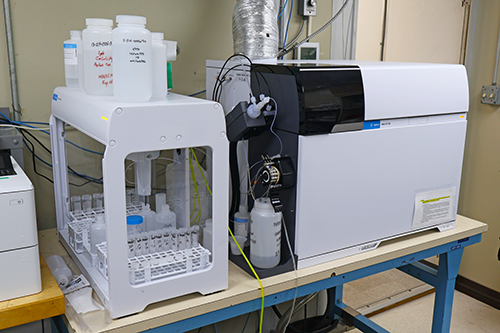
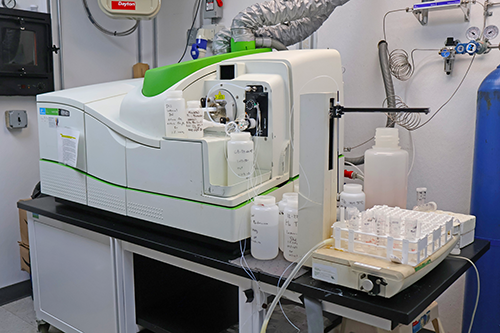
Inductively Coupled Plasma Mass Spectrometry (ICP-MS) is a powerful technique used to detect and quantify trace elements and heavy metals in a wide range of sample types. It works by ionizing the sample with plasma and then analyzing the ions based on their mass-to-charge ratio. ICP-MS is renowned for its
- Ultra-low detection limits (parts per billion)
- Wide dynamic range for major, minor, and trace elements
-
Multi-element analysis in a single run
RJ Lee Group uses ICP-MS for applications including environmental monitoring, industrial hygiene, materials characterization, and regulatory compliance.
What is ICP-MS?
Inductively Coupled Plasma - Mass Spectroscopy (ICP-MS) is an analytical technique that can measure most elements in the periodic table at very low concentrations. It works by using an inductively coupled plasma to atomize and ionize a sample, which is then sent into a mass spectrometer to be separated and detected based on its mass-to-charge ratio.
This makes it a versatile tool used in many industries, including environmental monitoring, raw material testing, and quality control.



What Can You Do With ICP-MS Analysis?
ICP-MS analysis is one of the most versatile tools in analytical chemistry, and RJ Lee Group applies it across a wide spectrum of industries and materials. Here are just a few of the ways our clients utilize our capabilities:
- Trace & Heavy Metals Detection
Enables the precise quantification of trace and toxic metals—including arsenic (As), beryllium (Be), cadmium (Cd), lead (Pb), and mercury (Hg)—at ultra-low concentrations. This capability is critical for environmental, health, and safety compliance across diverse sample types such as soil, drinking water, industrial effluents, raw material, and airborne particulates. - Rare Earth & Specialty Element Analysis
Premier technique for the quantitative analysis of rare earth elements (REEs) and other trace and ultra-trace elements in complex matrices. This supports advanced material characterization, environmental assessments, and industrial process monitoring. - Geological and mineral resource exploration, identifying REE concentrations in ores and sediments.
- Industrial byproduct characterization, such as fly ash, slag, and process residues for recycling or disposal.
- Advanced material development, supporting quality control in ceramics and alloys.
- Environmental impact studies, assessing dispersion and accumulation of REEs and actinides in ecosystems.
- Consumer Product & Coating Safety
Screen a wide array of materials—including ceramics, glassware, paints, pigments, and surface coatings—for hazardous substances such as lead (Pb), cadmium (Cd), arsenic (As), mercury (Hg), and antimony (Sb), which are subject to strict regulatory limits due to their potential health risks. - Compliance testing aligned with international standards such as
- U.S. Consumer Product Safety Commission (CPSC) regulations for lead in children’s products.
- California Proposition 65 for exposure to chemicals known to cause cancer or reproductive harm.
- RoHS directives, which restrict hazardous substances in electronics and consumer goods.
- ASTM, FCC, and USP methods for testing heavy metals in coatings and materials.
- Material & Industrial Characterization
Profile raw materials and byproducts (e.g., coal ash, gypsum, kaolin, talc) for quality control, process optimization, and failure analysis. - Environmental Monitoring and Industrial Hygiene
Elemental analysis of environmental and occupational samples, including soil, drinking water, groundwater, and ambient air particulates. This approach supports both routine monitoring and compliance-driven investigations in industrial hygiene and environmental health. - Assist school districts in identifying and mitigating lead contamination in drinking water systems.
Why Choose RJ Lee Group for ICP-MS Analysis?
RJ Lee Group leverages state-of-the-art ICP-MS technologies to deliver high-precision elemental analysis across solids, liquids, slurries, and air matrices.
- Advanced Instrumentation
Our labs feature the latest instrumentation systems, offering:- Robust performance with high-solids samples
- IntelliQuant full-element scans for interference detection
- Custom dwell times for enhanced sensitivity
- The helium collision cell and half-mass correction automatically remove polyatomic and doubly-charged ion interferences.
- Comprehensive Elemental Analysis
Can quantify rare earths, heavy metals, and trace elements using validated methods (e.g., EPA 6020, EPA 200.8, NIOSH 7300/7303), supporting environmental, occupational, and industrial testing. - Integrated Services & Expertise
ICP-MS techniques are combined with microscopy, XRF, SEM-EDS, and wet chemistry to provide a full picture of material composition, performance, and degradation. - Accredited & Compliant
RJ Lee Group operates under ISO 17025-accredited protocols and holds certifications from A2LA, AIHA LAP, and PA DEP. We follow ASTM, EPA, NIOSH, USP and FCC standards to ensure defensible, reproducible results. - Client-Focused Solutions
We offer fast turnaround and customized reporting tailored to regulatory and operational needs—from routine monitoring to litigation support.
Our team works closely with clients to ensure results are meaningful, actionable, and defensible.
Get in Touch
Whether you're investigating contamination, validating product safety, or conducting environmental assessments, RJ Lee Group is ready to help. Contact us to connect with one of our elemental analysis experts to discuss your project and develop a tailored analytical strategy to fit your needs.
Blog
Read More
2 min read
Environmental testing is getting more complex. Your laboratory partner should be keeping up.
September 15, 2026