




Author
Subscribe to our newsletter
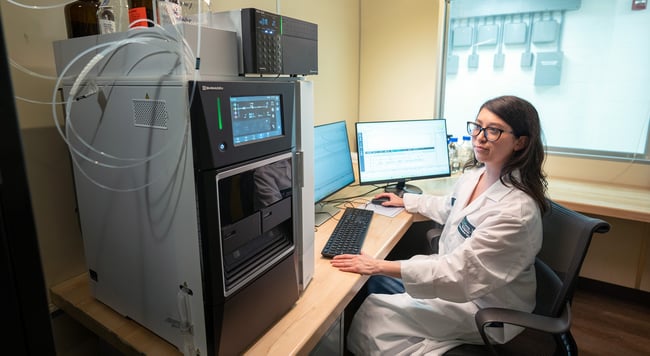
We’re excited to add Gel Permeation Chromatography (GPC) to our lab, further expanding our ability to deliver high-quality molecular weight characterization of polymers for research, product development, and quality applications.
Why GPC Matters:
Gel Permeation Chromatography (GPC), also called Size Exclusion Chromatography (SEC), is the gold standard for measuring polymer molecular weight distributions. This technology provides essential metrics, including the number-average molecular weight (Mn), weight-average molecular weight (Mw), and polydispersity index (PD).
These results help to analyze your polymers' performance, processing behavior, and long-term stability, information key to choosing the right manufacturing technique and how it will behave during its final use.
Polymers Commonly Analyzed by GPC
Our GPC system can analyze a wide range of soluble polymers and oligomers, including:
- Polystyrene and styrenic copolymers
- Poly(meth)acrylates (e.g., PMMA, acrylic and methacrylic resins)
- Elastomers (polybutadiene, natural rubber)
- Polyesters (PLA, PET oligomers, PCL), polyethers (PEG, PEO, PPO), polycarbonates, and polyurethanes
- Specialty functional polymers, resins, and binders
Why RJ Lee Group:
Our new system is built on the Shimadzu LC-2060C 3D platform, equipped with RID-20A and photodiode-array (UV/Vis) detectors. This versatile configuration enables us to analyze a wide range of polymers with confidence and precision.
A High-Performance Platform
The Shimadzu LC-2060C 3D provides accurate flow, steady pressure, and precise temperature—essential for reliable GPC results. Dual detection supports both universal and selective analysis.
- Refractive Index Detection (RID-20A) is best for general polymer analysis and concentration measurements.
- UV Detection targets polymers, copolymers, and additives with UV-active groups.
Standards and Calibration
We adjust our GPC settings using specific polystyrene standards, which is a reliable way to find out the relative molecular We modify calibration based on polymer type, solvent, and reporting requirements.
Unsure whether your polymer meets spec — or why a formulation isn't performing as expected? Molecular weight distribution is often the answer. Talk to our chemistry team about how GPC analysis can support your development, QA, or failure investigation work.