




Author
Subscribe to our newsletter
Fast, Reliable LC–MS/MS Analysis of Organic Acids — No Derivatization Required
Organic acids show up everywhere, in environmental matrices, biological systems, and engineered materials, but they're notoriously difficult to quantify. High polarity, structural similarity, and wide concentration ranges mean traditional methods often require derivatization, eat up prep time, and still produce inconsistent results.
If you're working in environmental monitoring, extractables and leachables, or materials degradation studies, we developed this method specifically to eliminate those bottlenecks.
A New Method from RJ Lee Group
RJ Lee Group continually invests in advanced analytical instrumentation like our Shimadzu LC-40 / 8060NX triple-quadrupole LC–MS/MS systems. Just as important, we develop new methods that push our instrumentation further. This new organic acid method expands the capabilities of our triple-quads into a class of compounds that have historically required workarounds.
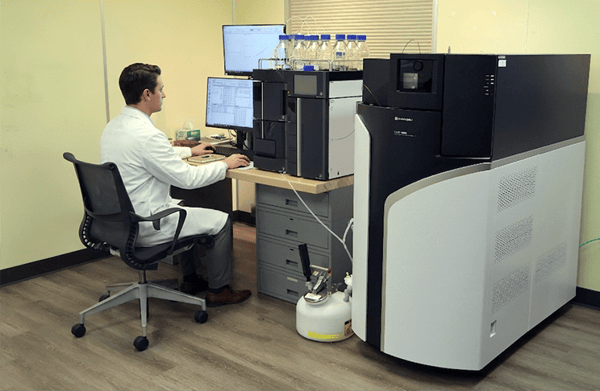
Here's why that matters.
Traditional organic acid analysis typically relies on GC-MS, which requires a derivatization step to make polar acids volatile enough for gas-phase separation. That added sample prep introduces variability, extends turnaround time, and can fail outright on certain acid classes. Ion chromatography is another option, but it often struggles with complex matrices and co-eluting peaks.
This method takes a different approach. It pairs the LC-MS/MS system with an Intrada Organic Acid column — a specialty column designed to separate polar organic acids directly, without derivatization. The column handles the separation; the triple-quadrupole mass spectrometer handles identification and quantitation using multiple reaction monitoring (MRM), which tracks specific molecular fragment patterns for each target acid. The result is confident identification even in samples where multiple acids are present at vastly different concentrations.
In practical terms: samples go in, results come out in about 10 minutes per run, with no derivatization step in between.
From Trace Detection to Routine Monitoring
The method covers a wide range of organic acids, from small volatile fatty acids to hydroxy-, dicarboxylic, and aromatic acids. Injection limits of quantitation span from low ng/mL to low µg/mL, enabling both trace-level detection and routine monitoring within a single workflow.
That range matters because organic acid panels rarely consist of one or two analytes at convenient concentrations. In real-world samples, you're often looking for a mix of acids spanning orders of magnitude, and this method handles that without needing to split the work across multiple runs or techniques.
Where This Method Makes a Difference
This isn't a method looking for a problem. It was developed to address specific analytical challenges across disciplines in which organic acids are either the target or the indicator.
-
Environmental Science
The method enables the study of natural organic matter cycling, biodegradation pathways, and contaminant fate in soil, sediment, and water. Detecting trace acids such as maleic, fumaric, malonic, and shikimic helps explain oxidation, microbial activity, and secondary formation processes — the kind of mechanistic detail that environmental assessments increasingly demand.
-
Materials Science
In engineered materials, organic acids often appear as residual monomers or additives, processing aids, or degradation byproducts. The method supports extractables/leachables studies, stability testing, and aging assessments, applications where trace organic acids serve as early warning signs of material degradation before macroscopic failure occurs.
Method at a Glance
| Parameter | Detail |
|---|---|
| Platform | Shimadzu LC-40 / 8060NX triple-quadrupole MS |
| Column | Intrada Organic Acid (Imtakt) |
| Separation time | ~10 minutes |
| Detection mode | MRM (multiple reaction monitoring) |
| Derivatization | Not required |
| Quantitation range | Low ng/mL to low µg/mL |
| Acid classes covered | Volatile fatty acids, hydroxy acids, dicarboxylic acids, aromatic acids |
Struggling with slow turnaround, derivatization headaches, or matrices that make organic acid quantitation unreliable? Our LC–MS/MS method was built to solve those problems. Talk to our chemistry team about whether it's the right fit for your samples.